Probably the least technologically advanced geoengineering technique I've come across so far - the 'Litre of Light' project started in the Philippines and invented by students at MIT.
It's not really aimed at fixing climate but I liked it anyway - basically it just involves filling a plastic bottle with water, cutting a hole in the roof and putting it inside.Then during daylight hours, light refracts through the bottle and lights up the room! So simple but very effective, as you can see from the video:
http://www.bbc.co.uk/news/world-asia-pacific-14967535
Obviously it's impractical for communities with access to electricity, but a good way to slightly improve conditions in slums and shanty areas, and it's emissions free! Maybe we should all live underground...
*p.s if anyone can tell me how to embed the video straight onto the blog I'd be grateful, I'm quite computer retarded
Thursday, 24 November 2011

Tuesday, 22 November 2011
Are Iceland afforesting role models?
Iceland have also experienced deforestation and desertification in the past but for at least a century (since 1899 in fact (Lal 2009)) have been afforesting and re-vegetating, meaning they are one of the pioneers in terms of this geoengineering technique so can be used as a model for its usefulness. The Goverment, NGOs, farmers and individuals contribute to the protection of soil and afforestation practices; and have been very successful so far.
Subsequently, Iceland is on track for meeting Kyoto's higher targets and their successfulness at carbon sequestration means afforestation and soil conservation are considered feasible techniques within the role of mitigating climate change.
4-5 millions trees were being planted annually by the 1990s and by the 2000, 84 million trees had been planted in total (Lal 2009). The government also increased the budget for afforestation by €6m in 2000 (Sigurdsson and Snorrason 2000) with the sole purpose of improving carbon sequestration.
The following table illustrates Iceland's carbon budget on a yearly basis:
Table 1: Lal 2009.
If estimations are correct, Iceland is now an emissions free nation!
Subsequently, Iceland is on track for meeting Kyoto's higher targets and their successfulness at carbon sequestration means afforestation and soil conservation are considered feasible techniques within the role of mitigating climate change.
4-5 millions trees were being planted annually by the 1990s and by the 2000, 84 million trees had been planted in total (Lal 2009). The government also increased the budget for afforestation by €6m in 2000 (Sigurdsson and Snorrason 2000) with the sole purpose of improving carbon sequestration.
The following table illustrates Iceland's carbon budget on a yearly basis:
| Process | Quantity (Tg C yr−1) |
|---|---|
| I. Sources | |
| 1. Degassing from volcanoes | 0.33–0.60 |
| 2. Anthropogenic emissions in 1990 | 0.55–0.70 |
| 3. Erosion-induced emissions | 0.01–0.02 |
| Total Sources | 0.94–1.42 |
| II. Sinks | |
| 1. Permanent uptake by Ca+2 and Mg+1 | 0.29 |
| 2. SOC sequestration in restoring eroded soils | 1.0 |
| 3. Above ground biomass C in vegetation | 0.2–0.6 |
| 4. Emission avoidance from erosion control | 0.01–0.02 |
| Total Sink | 1.50–1.9 |
Table 1: Lal 2009.
If estimations are correct, Iceland is now an emissions free nation!
| So how much carbon will changing forestry practices actually remove then? A paper by Nilsson and Schopfhauser (1995) calculated potential changes in the carbon cycle with a large-scale, global afforestation effort. They estimated a total of 345m ha of land is available for planting, but they also ensure their proposal is socially, economically and politically feasible, therefore substantially less land is really available for plantations and agroforestry. Nilsson and Schopfhauser confirmed it would take a very long time in order to fix reasonable amounts of carbon both above and below ground - this is summarized in table 1 below: Year MAI Annual carbon (million m3/yr) fixation (million t/yr) 2015 1122 407 2025 1784 635 2035 2411 864 2045 2734 991 2055 3112 1140 2070 3000 1092 2085 2879 1058 2095 2918 1084 (Source: Nilsson and Schopfhauser 1995) The effects of afforestation would only be significant after 40-50 years, and would stabalise after 60 years (2095), removing 1.5Gt per annum. Unfortunately, the authors conclude this is less than half of the 3.8Gt or carbon which is currently emitted each year, but, could sequester around 30% of anthropogenic emissions. So overall then.. Afforestation is certainly not a short term solution! And not all that effective (at least for half a century), feasible or measurable either. Generally there is no consensus on how much afforestation is required to offset emissions, as shown in the table below:  (Source: Andrasko 1990) There are many constraints; the more difficult probably being social reasons. Planting trees soley to uptake carbon is a difficult concept to apply in practice. Grainger (1991) summarised this by saying "even if environmental quality and economic productivity are both low, those who use the land may be unwilling to convert it to forest". However, environmental constraints also exist, especially when reforesting in the tropics where much of the soil is degraded, and also in terms of climate suitability. Additionally, it is also important to select the correct type of tree (as seen with China) if afforestation programs are to succeed, to ensure survival and long term sustainability. It can be effective, as illustrated by Iceland but this may only be due to their small economy. It could potentially be good coupled with another geoengineering technique(s), as any increase in forest biomass will sequester CO2, but alone could not deliver the means to solve the emissions problem. | |
Thursday, 17 November 2011
The green wall of China
Afforestation is a controversial topic in terms of it's success. Since 1978 Northern China has been undergoing the hugest afforestation/reforestation effort ever (Cao et al 2010), and we'll see if they're succeeding.
Historically China has destroyed most of its forests; but in recent decades steps have been taken to replant trees and reverse the damage done by deforestation. The largest project underway is the 'Green Wall of China' - this involves artificially planting strips of forest to not only restore trees but to stop the expansion of the Gobi desert.
 Fig 1: Map of the Green Wall scheme (Wang et al 2010)

Because of this China has the highest rate of afforestation in the world, and saw a 31.6% increase in forest cover between 1990-2010 (UN stats 2010).
However, I've looked at several papers regarding the scheme and most seem to conclude that it is either unsuccessful or the outcome is unmeasurable, for many reasons.
Cao (2008) concluded the best strategy would be for the government to reduce funding for afforestation as a result of the reasons aforementioned, and spend more money and effort on alternative strategies to combat desertification. Wang et al (2010) challenges the Chinese governments evaluation of the project - although they claim it is a success and has provided environmental improvement, other evidence proves otherwise. They conclude more evidence is required into both proving or disproving the success of the project; as a basis for important future decision making with regards to improving the environment. Cao et al (2010) suggest that the project will be more successful if more research and thought is put into selecting the type of vegetation, as well as taking other measures into consideration such as stopping deforestation or changing agricultural practices.
From what I read, it's obvious a huge amount of money has been invested in afforestation in China, not only in the green belt project but 5 other major projects also (Cao et al 2010). Such huge afforestation efforts are commendable but it worries me that they just plant any old trees as opposed to taking into account factors such as hydrology and climate to determine the right type of vegetation to plant. Surely this would save money and enhance survival rate? Obviously choosing fast-growing trees might be a priority but if only 15% of them survive then why bother... I disagree with Cao (2008) in reducing the government funding to afforestation schemes, they just need to invest in the correct type of vegetation to yield better results, and understand that you can't plant a forest anywhere!
Also, I didn't come across any papers on evaluating how afforestation in China was capturing carbon, they seem more concerned with planting forests in order to combat desertification and stop soil erosion and water depletion. This also worries me because China is the worst offender for emitting GHGs.. although planting trees will always eventually capture carbon, this can take centuries. Nevertheless billions of hectares have been planted on and it would be interesting to know exactly how much more is required to offset their emissions.
Cao, S. (2008) 'Why large-scale afforestation efforts in China have failed to solve the desertification problem', Environmental Science Technology, 42, 6, 1826-1831.
Cao, S., L. Chen, D. Shankman, C. Wang, X. Wang and H. Zhang (2010) 'Excessive reliance on afforestation in China's arid and semi-arid regions: Lessons in ecological restoration', Earth-Science reviews, 104, 4, 240-245.
Wang, X., C. Zhang, E. Hasi and Z. Dong (2010) 'Has the Three Norths Forest Shelterbelt Program solved the desertification and dust storm problems in arid and semiarid China?', Journal of Arid Environments, 71, 1, 13-22.
Historically China has destroyed most of its forests; but in recent decades steps have been taken to replant trees and reverse the damage done by deforestation. The largest project underway is the 'Green Wall of China' - this involves artificially planting strips of forest to not only restore trees but to stop the expansion of the Gobi desert.

Due for completion in 2050, the trees will stretch 4500km. China achieves it's afforestation goals in several ways, including aerial seeding, providing incentives to farmers to grow trees on their land, and the requirement for every citizen aged 11+ to plant one tree a year.

Fig 2: Graph showing afforestation in China 1952-2005 (Cao 2008)
Because of this China has the highest rate of afforestation in the world, and saw a 31.6% increase in forest cover between 1990-2010 (UN stats 2010).
However, I've looked at several papers regarding the scheme and most seem to conclude that it is either unsuccessful or the outcome is unmeasurable, for many reasons.
- Cao (2008) concluded afforestation caused more environmental degradation than before the project started, as amount of degraded land is expanding.
- Only 15% of the trees planted actually survived (Cao 2008), (Cao et al 2010).
- The remaining trees were predominantly dwarf trees, which are less effective at capturing carbon
- The trees soak up the groundwater and cause groundwater problems and water stress upon themselves, especially in N China which has an arid climate (Cao et al 2010).
- Pollution has weakened the soil and made many places unsuitable for planting.
- Loss of biodiversity.
- Unsuitability of planted trees to China's climate (Cao 2008). Natural vegetation in this area was actually desert steppe or dryland shrubs.
- Proper evaluation or assessment of the program's efforts and effects cease to exist (Wang 2010).
Cao (2008) concluded the best strategy would be for the government to reduce funding for afforestation as a result of the reasons aforementioned, and spend more money and effort on alternative strategies to combat desertification. Wang et al (2010) challenges the Chinese governments evaluation of the project - although they claim it is a success and has provided environmental improvement, other evidence proves otherwise. They conclude more evidence is required into both proving or disproving the success of the project; as a basis for important future decision making with regards to improving the environment. Cao et al (2010) suggest that the project will be more successful if more research and thought is put into selecting the type of vegetation, as well as taking other measures into consideration such as stopping deforestation or changing agricultural practices.
From what I read, it's obvious a huge amount of money has been invested in afforestation in China, not only in the green belt project but 5 other major projects also (Cao et al 2010). Such huge afforestation efforts are commendable but it worries me that they just plant any old trees as opposed to taking into account factors such as hydrology and climate to determine the right type of vegetation to plant. Surely this would save money and enhance survival rate? Obviously choosing fast-growing trees might be a priority but if only 15% of them survive then why bother... I disagree with Cao (2008) in reducing the government funding to afforestation schemes, they just need to invest in the correct type of vegetation to yield better results, and understand that you can't plant a forest anywhere!
Also, I didn't come across any papers on evaluating how afforestation in China was capturing carbon, they seem more concerned with planting forests in order to combat desertification and stop soil erosion and water depletion. This also worries me because China is the worst offender for emitting GHGs.. although planting trees will always eventually capture carbon, this can take centuries. Nevertheless billions of hectares have been planted on and it would be interesting to know exactly how much more is required to offset their emissions.
Cao, S. (2008) 'Why large-scale afforestation efforts in China have failed to solve the desertification problem', Environmental Science Technology, 42, 6, 1826-1831.
Cao, S., L. Chen, D. Shankman, C. Wang, X. Wang and H. Zhang (2010) 'Excessive reliance on afforestation in China's arid and semi-arid regions: Lessons in ecological restoration', Earth-Science reviews, 104, 4, 240-245.
Wang, X., C. Zhang, E. Hasi and Z. Dong (2010) 'Has the Three Norths Forest Shelterbelt Program solved the desertification and dust storm problems in arid and semiarid China?', Journal of Arid Environments, 71, 1, 13-22.
Wednesday, 16 November 2011
Afforestation/Reforestation
Afforestation: Establishing trees in an area where there was never any forest.
Reforestation: Re-establishing forest cover naturally or artificially.
Afforestation is considered a cheap and safe technique; although not as effective at CO2 removal perhaps than other, more technologically advanced techniques. However, it is advantageous in the way that it removes carbon from the atmosphere and sequesters it, unlike solar management methods.
Deforestation occurs all around the world, although rates vary spatially. It has been recognised as a major contributor to global warming, and as a result many governments and NGOs are undertaking steps to try to reverse the process. Overall, the amount of deforestation is decreasing on a global scale (FAO 2001), and afforestation (in some countries) is increasing simultaneously. Biggest forest loss occurs in tropical regions and the biggest forest cover gains in temperate and boreal regions (FAO 2011), as well as emerging economies such as China.
There is loads of literature on this topic and I'll look at some of the big policies and schemes in more detail, to evaluate afforestations usefulness as a geoengineering technique. At the moment I like it because it's green and can't do much harm to the environment, but by the time the trees have grown and started to sequester carbon it might be too late!
Here is some other interesting stuff on the topic:

A visual representation of the FAO's annex table 2.
Reforestation: Re-establishing forest cover naturally or artificially.
Afforestation is considered a cheap and safe technique; although not as effective at CO2 removal perhaps than other, more technologically advanced techniques. However, it is advantageous in the way that it removes carbon from the atmosphere and sequesters it, unlike solar management methods.
Deforestation occurs all around the world, although rates vary spatially. It has been recognised as a major contributor to global warming, and as a result many governments and NGOs are undertaking steps to try to reverse the process. Overall, the amount of deforestation is decreasing on a global scale (FAO 2001), and afforestation (in some countries) is increasing simultaneously. Biggest forest loss occurs in tropical regions and the biggest forest cover gains in temperate and boreal regions (FAO 2011), as well as emerging economies such as China.
There is loads of literature on this topic and I'll look at some of the big policies and schemes in more detail, to evaluate afforestations usefulness as a geoengineering technique. At the moment I like it because it's green and can't do much harm to the environment, but by the time the trees have grown and started to sequester carbon it might be too late!
Here is some other interesting stuff on the topic:
- Most deforested countries in the world, produced by the FAO.
- Most re-forested countries, also produced by the FAO.
- Another FAO publication assessing the state of the world's forests, it's nice because it's broken down into small regions. And in the annex, table 2 has figures for forest area and forest area change for every country 1990-2010.
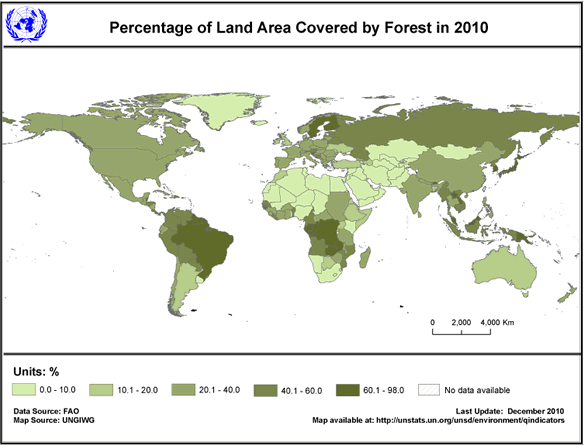
A visual representation of the FAO's annex table 2.
- 23rd April 2011 saw over 100 cities worldwide plant trees as part of 'Earth Day' celebrations - I'd never heard of this Earth day before but it looks pretty good they promote and actively do LOADS of stuff for the environment.
Wednesday, 9 November 2011
Delay in the testing of SSAs
I just read this article on BBC news - the UK based SPICE project (a 3.5 year project involving several universities, the MET office and various other organisations) have had to postpone their experiment due to pressure from critics and opposition.
'Energising the city'
This is one of UCL's lunch hour lectures given by Yvonne Rydin from the Bartlett School of Planning. She talks about how to provide energy to cities in the future as an alternative to using fossil fuels.
Incase you're wondering how this is related to geoengineering, she is talking about how to combat global warming and reduce carbon emissions by using renewables and lots of other geoengineering techniques (such as carbon capture, solar power).
You can listen to it here:
Incase you're wondering how this is related to geoengineering, she is talking about how to combat global warming and reduce carbon emissions by using renewables and lots of other geoengineering techniques (such as carbon capture, solar power).
You can listen to it here:
It's not greatly in-depth but good nonetheless.
Tuesday, 8 November 2011
Natural geoengineering
Still on the topic of stratospheric sulfate aerosols I looked at a publication by the USGS about this occurring naturally in the form of a volcanic eruption, and the atmospheric impact sulfates have. The Mt Pinatubo eruption in 1991 famously cooled the planet for several years, and this is important because of course it was natural - the event can be used in models and case studies to determine what effects injected sulfate will have round the world.
Pinatubo added around 17 Mt of SO2 into the lower/middle stratosphere (34-37km); the largest since Krakatau. The aerosol cloud then took 3 weeks to spread round globe and around a year to attain global coverage.
The cloud persisted for 3 years at concentrations much larger than background levels. It affected optical properties of the atmosphere, such as unusual colouring of sunrises and sunsets and whitening of the sun.
Positives:
- The magnitude of the aerosol cloud decreased the amount of net radiation reaching the surface of Earth - cooling in the N. hemisphere was -0.5-0.7 degrees, and still -0.4 degrees in 1992-1993
- Eruption effects were strong enough to override the effects of El-Nino and anthropogenic global warming between 1991-1993.
- Can be used as a model for aerosol dispersal, circulation and decay.
Negative:
- Midlatitude ozone concs. reached lowest-ever recorded levels between 1992-1993.
- Ozone depletion rates were observed to be faster than ever recorded before.
- Half of the ejected sulfur converted to sulfuric acid 3 weeks to a month after the eruption.
- Higher than usual amounts of cirrus clouds in the upper trophosphere leading to surface warming, as the transport of aerosols from the stratosphere to the trophosphere caused sulfur-induced changes in atmospheric dynamics.
Effects on weather and climate (locally)
Impacts on Ozone
Ozone is important in the upper atmosphere as it blocks harmful incoming electromagnetic radiation from the sun. Chemical reactions taking place on the injected sulfate particles cause active ozone destruction.
- In the tropical stratosphere, ozone concentrations decreased as much as 20% 3-6 months post-eruption.
- 20% ozone depletion measured over the states of Colorado and Hawaii.
- Mid-latitude ozone abundance was at the lowest-ever recorded levels between 1992-1993.
- In Antarctica 1991-1992 was huge decreases in ozone abundance and rates of destruction.
Conclusion
This natural geoengineering event proves that unfortunately there are unwanted side effects at a local and regional level, as sulfate aerosols affect atmospheric circulation and weather patterns. Other ill effects include changes in atmospheric composition in the upper stratosphere; which is really important for protecting the Earth from electromagnetic radiation. Rates of destruction of ozone reached critical levels after the eruption of Pinatubo and the depletion of the ozone layer also increased dramatically.
The eruption did cause large scale surface cooling for at least 3 years post-eruption; weather patterns causing the most dramatic cooling of -0.5-0.7 degrees in the Northern hemisphere. This is proof that sulfate injections can be used as a tool to combat global warming; especially as it managed to offset both anthropogenic warming and the El-Nino conditions. The Pinatubo eruption can be used to build in-depth models of potential climate impact, especially with the analysis of surface temperatures and weather patterns. Knowledge gained from this can then obviously be applied to artificial injection situations to determine their effects at the surface.
Although I still think injecting sulfate aerosols into the stratosphere is an excellent idea and one of the more feasible; there is unfortunately going to be a trade off between cooling the planet and causing destruction of ozone and alteration of atmospheric composition. I still believe it may be possible to find a way to bypass the problems associated with the technique, and nevertheless it is still a really important option to consider, especially as the technique can reverse global warming (as seen by cooling after Pinatubo) by blocking incoming radiation. It's also important to remember that injecting aerosols is something readily available and this may turn up to be very important in the next few years; and also the cost of the technique is comparatively low to other methods.

Self, S., J-X. Zhao, R. Holasek, R. Torres and A. King (1999) 'The atmospheric impact of the 1991 Mount Pinatubo eruption', (WWW) Washington: U.S Geological Survey (http://pubs.usgs.gov/pinatubo/self/index.html; 07/11/11).
Pinatubo added around 17 Mt of SO2 into the lower/middle stratosphere (34-37km); the largest since Krakatau. The aerosol cloud then took 3 weeks to spread round globe and around a year to attain global coverage.
The cloud persisted for 3 years at concentrations much larger than background levels. It affected optical properties of the atmosphere, such as unusual colouring of sunrises and sunsets and whitening of the sun.
Positives:
- The magnitude of the aerosol cloud decreased the amount of net radiation reaching the surface of Earth - cooling in the N. hemisphere was -0.5-0.7 degrees, and still -0.4 degrees in 1992-1993
- Eruption effects were strong enough to override the effects of El-Nino and anthropogenic global warming between 1991-1993.
- Can be used as a model for aerosol dispersal, circulation and decay.
Negative:
- Midlatitude ozone concs. reached lowest-ever recorded levels between 1992-1993.
- Ozone depletion rates were observed to be faster than ever recorded before.
- Half of the ejected sulfur converted to sulfuric acid 3 weeks to a month after the eruption.
- Higher than usual amounts of cirrus clouds in the upper trophosphere leading to surface warming, as the transport of aerosols from the stratosphere to the trophosphere caused sulfur-induced changes in atmospheric dynamics.
Effects on weather and climate (locally)
- The USA experienced the third coldest and wettest summer in 77 years in 1992.
- Extensive Mississippi floods in summer 1993.
- Drought in the Sahel.
- Many other areas experienced above-average warm conditions, showing cooling isn't spatially uniform.
Impacts on Ozone
Ozone is important in the upper atmosphere as it blocks harmful incoming electromagnetic radiation from the sun. Chemical reactions taking place on the injected sulfate particles cause active ozone destruction.
- In the tropical stratosphere, ozone concentrations decreased as much as 20% 3-6 months post-eruption.
- 20% ozone depletion measured over the states of Colorado and Hawaii.
- Mid-latitude ozone abundance was at the lowest-ever recorded levels between 1992-1993.
- In Antarctica 1991-1992 was huge decreases in ozone abundance and rates of destruction.
Conclusion
This natural geoengineering event proves that unfortunately there are unwanted side effects at a local and regional level, as sulfate aerosols affect atmospheric circulation and weather patterns. Other ill effects include changes in atmospheric composition in the upper stratosphere; which is really important for protecting the Earth from electromagnetic radiation. Rates of destruction of ozone reached critical levels after the eruption of Pinatubo and the depletion of the ozone layer also increased dramatically.
The eruption did cause large scale surface cooling for at least 3 years post-eruption; weather patterns causing the most dramatic cooling of -0.5-0.7 degrees in the Northern hemisphere. This is proof that sulfate injections can be used as a tool to combat global warming; especially as it managed to offset both anthropogenic warming and the El-Nino conditions. The Pinatubo eruption can be used to build in-depth models of potential climate impact, especially with the analysis of surface temperatures and weather patterns. Knowledge gained from this can then obviously be applied to artificial injection situations to determine their effects at the surface.
Although I still think injecting sulfate aerosols into the stratosphere is an excellent idea and one of the more feasible; there is unfortunately going to be a trade off between cooling the planet and causing destruction of ozone and alteration of atmospheric composition. I still believe it may be possible to find a way to bypass the problems associated with the technique, and nevertheless it is still a really important option to consider, especially as the technique can reverse global warming (as seen by cooling after Pinatubo) by blocking incoming radiation. It's also important to remember that injecting aerosols is something readily available and this may turn up to be very important in the next few years; and also the cost of the technique is comparatively low to other methods.

Self, S., J-X. Zhao, R. Holasek, R. Torres and A. King (1999) 'The atmospheric impact of the 1991 Mount Pinatubo eruption', (WWW) Washington: U.S Geological Survey (http://pubs.usgs.gov/pinatubo/self/index.html; 07/11/11).
Subscribe to:
Posts (Atom)